





Tesla Superchargers Come To Volkswagen In 2025 At Latest; VW Wants AC Charging Too
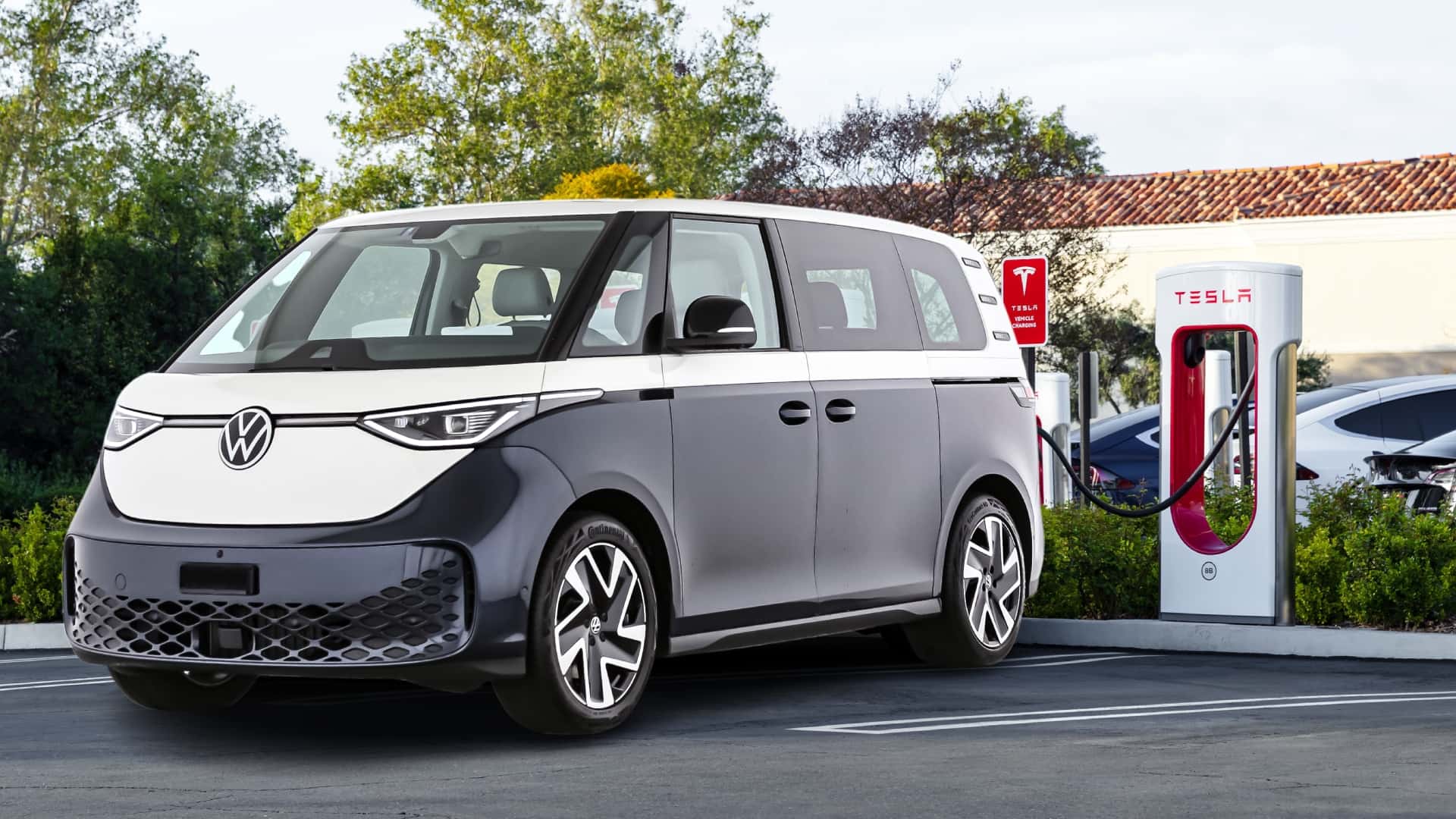
If you’re a Volkswagen EV owner and you’re enviously looking at how Ford drivers can access Tesla’s Supercharger network, you have a little longer to wait. The Volkswagen Group will have a Tesla North American Charging Standard (NACS) adapter available for its EVs in 2025 “at the latest”, a VW spokesperson told InsideEVs. That means you’ll finally be able to charge your ID.4 or Porsche Taycan at a Supercharger. But with Ford and Rivian already enabling Supercharger access this month, we had to ask what was taking so long.
The first hurdle is obvious. Volkswagen announced its deal with Tesla late in 2023, after many other brands had already committed. Ford was the first to announce a deal, and it’s no surprise that it’s the first company to ship adapters.
Those adapters, though, aren’t as easy to build as you might expect.
Get Fully Charged
The Great NACS Migration
Almost all EVs on sale use the Combined Charging Standard (CCS) connector. The biggest exception is Tesla, which uses the North American Charging Standard (NACS) and operates its own fast-charging Supercharger network. Ford and Rivian owners are getting access to Superchargers this month via NACS adapters, with most automakers set to follow shortly after. By 2026, new models from most major brands will come from the factory with NACS ports.
One challenge was making sure VW drivers could charge their EVs at Tesla’s AC slower current Destination chargers; right now, Ford drivers cannot. They are limited only to the faster DC Supercharger stations, Ford officials confirmed last week.
The existing Combined Charging Standard (CCS) chargers use separate pin configurations for alternating current (AC) slow charging and direct current (DC) fast charging. A slow charger uses the top rounded hole, whereas a fast charger uses that port in addition to two extra pins below it.
As soon as you plug a connector in, the car knows whether it’s dealing with AC or DC. AC has to be converted by the car’s onboard charger, while DC can go directly to the battery. The NACS connector is the same for fast and slow charging, which means the car has to figure out whether it’s receiving DC or AC current, and route it automatically.
CCS cars weren’t built to do that, so any manufacturer who wants to make an adapter work in AC and DC charging conditions has to build that functionality into the adapter.
“We just want to investigate and make sure that any adapter we produce works perfectly with AC and DC. To do that will take quite a bit of time,” VW spokesperson Mark Gillies told InsideEVs.
Ford solved this problem a different way. Rather than trying to build an adapter that can handle both AC and DC charging, it shipped one that only supports DC fast charging. This makes some amount of sense, as most AC charging happens at home when you can just use the correct plug. Slow chargers are also much cheaper and the cables don’t need to be cooled, so it’s relatively easy to change what connector one uses.
Batteries only work with direct voltage, and Gillies notes that VW wants to ensure any charger it provides to consumers can handle any foreseeable situation safely.
Regardless, the time crunch is on, as most manufacturers have to have their adapters ready by the end of 2025. Gillies suggested that there’s still work to do there, and that it was too early to answer specifics about whether VW owners would need separate apps to charge at a Supercharger, whether plug-and-charge would work, and whether its vehicles on-board route planners will support Superchargers in the future.
The good news is that the AC/DC switching problem won’t last long. Starting in 2026, every refreshed or redesigned VW Group EV will get NACS support from the factory, so the car will be able to handle the switch internally.
Additionally, the first VW Group product to get the new NACS port should be the next refresh of the Porsche Taycan in 2026. Given the 2024 Taycan’s unbelievable charging performance in our most recent test, we’re excited for one of our favorite (and quickest) EVs to get native access to the best charging network in America.
 Swiss Chamber of Commerce in Egypt hosts panel on EU-Egypt trade, investment – Dailynewsegypt
Previous
Swiss Chamber of Commerce in Egypt hosts panel on EU-Egypt trade, investment – Dailynewsegypt
Previous
 TAQA plans to quadruple its investments in Egypt in two years – Dailynewsegypt
Next
TAQA plans to quadruple its investments in Egypt in two years – Dailynewsegypt
Next